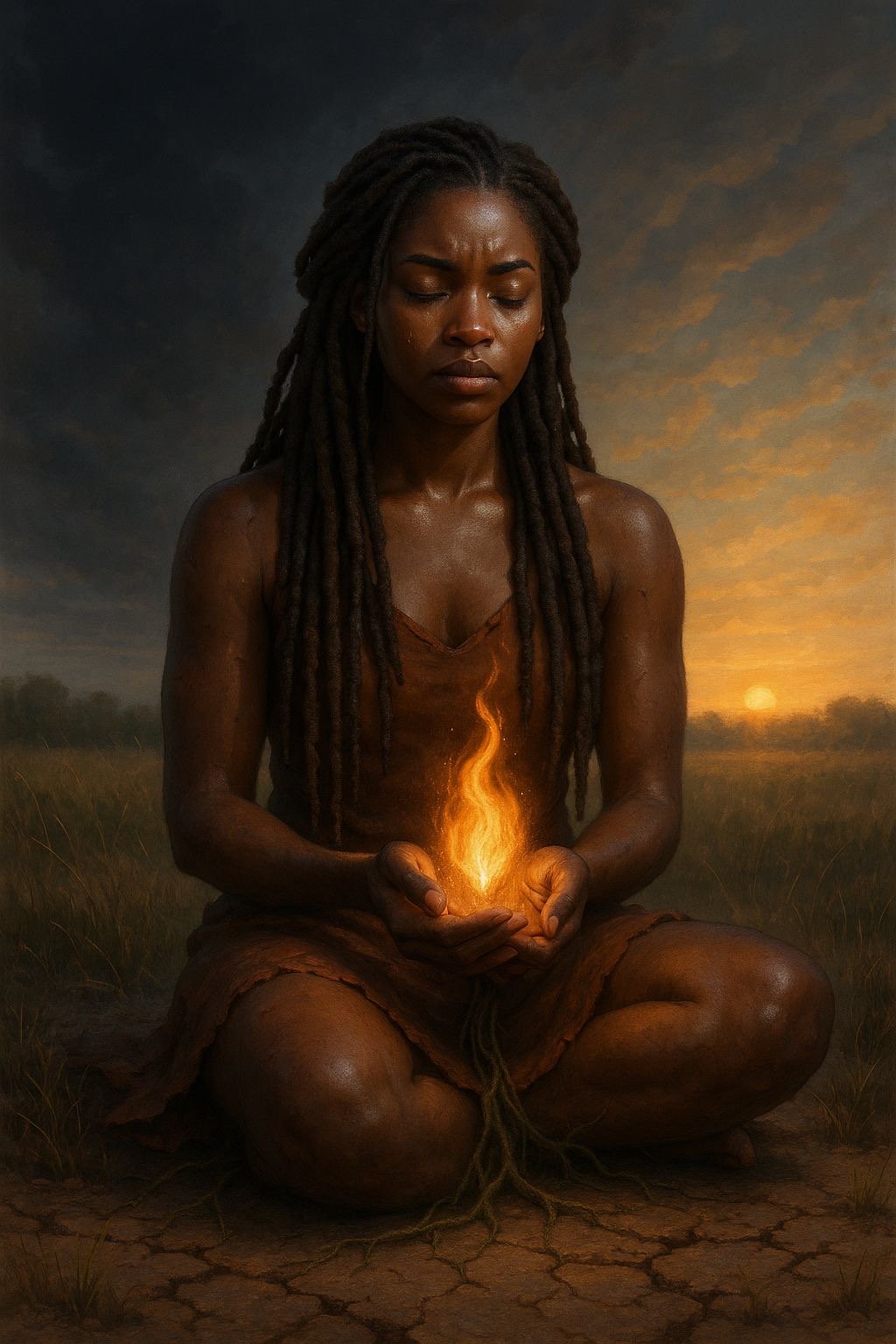
Long before written history and long before borders were drawn, she stood. Her name was Lucy — Dinkinesh in Ethiopia — meaning “you are marvelous.” Found in the Awash Valley of Ethiopia, Lucy is not just an archaeological discovery. She is the mother of all humankind, the first to walk upright, the beginning of us all. Africa gave birth to the first human being. And that first human? Was a woman.

From the beginning, the African woman has carried not just her children, but the very weight of humanity. She is the nurturer, the protector, the silent architect of society. Her arms are the first cradle. Her back is the first classroom. Her songs are the first lullabies and her wisdom the first philosophy.
The First Cradle Was Her Arms
The African woman has always been more than a caretaker — she is the very foundation of life.
She doesn’t just raise children.
She raises nations.
Even without formal education, she is a living archive of wisdom:
She knows which herb will cool a fever,
Which root will calm a cough,
Which song will ease a child’s fear in the dark.

She carries her newborns tied tightly to her back, their tiny hearts resting against hers — beating in rhythm.
She stays awake through the night, alert to every breath, every movement.
She protects them with a strength that goes beyond the physical — it’s spiritual.
Raised by a Village. Raised by a Queen.
In many Black communities across Africa and the world, the love for Mama is sacred.
Even when resources are few, her resourcefulness is endless.
Even when exhausted, she finds a way.
Even when overlooked, she never forgets her purpose.
It is said:
“If you educate a man, you educate an individual. If you educate a woman, you educate a nation.”
But African women, even when not educated formally, carry a knowledge older than books — a knowing rooted in generations.

She Led Before She Was Ever Given Permission
While many parts of the world are just beginning to give women political voices, Africa has always known female power.
Not just in homes, but on thrones.
Not just in rituals, but in wars.
There was the Queen of Sheba, who journeyed across kingdoms to meet King Solomon — bearing treasures, wisdom, and her own sovereignty. She returned pregnant, ensuring her lineage would be one of divine blood. That wasn’t seduction — it was strategy. A power move. A mother move.
There was Yaa Asantewaa of Ghana, who led the Ashanti rebellion against the British, commanding an army with fire in her heart and liberation on her tongue.
There was Queen Nzinga of Angola — a diplomat, warrior, and master tactician who stood unbent before European colonizers.
And let us not forget the Dahomey Amazons, an elite all-female military force in present-day Benin, who struck fear into colonial powers.
These women were not waiting to be empowered.
They were the power.

Spirit Flows Through Her
African spirituality has always known what the modern world is only beginning to understand: the divine is not one gender — it is both.
Among the Oromo people of Ethiopia, women once served as Qaallittii — female spiritual leaders, priestesses, and protectors of balance.
In traditional religions from West to Southern Africa, goddesses, mothers, and priestesses were central to rituals, healing, and cosmic order.
To be a woman was not just biological — it was sacred.

She Is Rising Again
Today, the African woman is no longer just holding the past — she is shaping the future.
In the United States, Black women are now the most educated demographic group.
Across Africa and the diaspora, they are leading in business, art, science, activism, and technology.
They are reclaiming their hair, their language, their history, and their power.
They are telling new stories — without erasing the old ones.
They are returning to their roots, and from those roots, they are growing entire forests of change.
She Is the Beginning. She Is the Bridge. She Is the Becoming.
She who carries the world on her back is no longer carrying it alone.
She is being seen. She is being honored. She is being remembered.
And with platforms like Webzzy Africa, we make sure her story is told, her business is known, and her legacy is immortal.
✨
Create your own space online — for your voice, your story, or your dream. Webzzy Africa offers free websites for every African person, because every story, especially hers, deserves to live forever.